
That Time Oakland Nearly Vanished

Oakland, Orange County, Florida
By Richard Lee Cronin
A quarter-century of history about the earliest days of the quaint little residential community of Oakland, West Orange County, Florida, has been largely forgotten. Typically thought of as a railroad town established by James G. Speer in 1886-87, a city that thereafter grew to become Orange County’s largest city of 400 residents in the 1890s, one could wrongly conclude that Oakland’s founding traces to that arrival in the 1880s of a railroad.

Oakland, West Orange County, Florida in the 1890s
The history of Oakland, however, traces to two plantations established during the mid-1850s. By 1860, both plantations had new owners. James G. Speer and his first wife Isaphoenia relocated in 1858 from Lake Ivanhoe, near Orlando, to settle on one of the two established plantations. In 1860, William C. Roper brought several families with his from Georgia to settle on the other plantation. Both families owned hundreds of acres along the south shore of Lake Apoka, land that is now the towns of Oakland and Winter Garden.
William C. Roper became postmaster a new “Oakland Post Office” on October 12, 1860, the earliest date that the name “Oakland” is known to have been connected to a settlement on the south shore of Lake Apopka. Roper served as postmaster for a little more than a year, until the post office closed in 1861 at the start of the Civil War. Roper’s Oakland of 1860 became known as Winter Garden in the mid-1880s.
Twenty-seven years after Roper opened his Oakland Post Office, James G. Speer, in 1887, opened a new “Oakland Post Office.” Speer’s post office was located on his “Oakland estate,” several miles west of where William C. Roper’s post office had been in 1860. James G. Speer also Platted a “Town of Oakland” on his nearly 700-acre estate and then convinced The Orange Belt Railway to headquarter in his town.
Twenty-seven years and about three miles separate William C. Roper’s 1860 Oakland Post Office and James G. Speer’s 1887 Oakland Post Office. Twenty-seven years and a whole lot of history!
A Civil War and the Reconstruction Period:
Orange County was no different than much of the South following the Civil War. One-third of the County’s 270 young men sent off to serve in the Confederacy never came home. In 1867, a special census found a larger Orange County population but only because of the number of very young children. Of 1352 White inhabitants in 1867 Orange County, 55%, or 746, were children living in 97 households (an average of 7.6 children per household). Orphans had come to Florida from war-torn parts of the South to reside with their aunts and uncles.
The Speer family was not among the 1867 Orange County citizens. James & Isaphoenia had by then sold their Oakland estate and relocated further southwest. With them went Thomas H. Harris family from Orlando; Speer’s daughter Catherine E. (Speer) Sadler, and their grandson, James Hardy Sadler. Catherine’s husband had died in the Battle for Vicksburg in May 1863.
The group settled along the Gulf Coast in what is now Dunedin, Pinellas County. Isaphoenia (Ellington) Speer died here in 1867. Catherine remarried here in 1868, to Major Josiah R. Wise, a veteran of the Civil War who had homesteaded 160 acres on the Gulf in 1865. James G. Speer sold some of the family’s Orange County property while a resident of Pinellas County in 1868.
Meanwhile, back in Orange County, James and Sansparilla Jackson, the couple who purchased the Oakland estate from the Speer’s, both died in 1868. On 7 February 1869, Mary Jackson, the daughter of James and Sansparilla, married James G. Speer. James, it seems, his daughter
Catherine, son-in-law Josiah, and grandson James Hardy Sadler, had by then all returned to the south shore of Lake Apopka.
Returning Home to a New Life:
Had James G. Speer preferred the balmy breezes and sandy beaches to lakeside living in West Orange County a town of Oakland, Florida would likely not exist today. Back in his old home, James took back control of nearly 700 crucial West Orange County acres. To travel east-west along the southern shore of Lake Apopka north of Johns Lake one had to cross Speer land, a worthy selling point when it came time in 1886 to negotiate with The Orange Belt Railway.
James G. Speer had grown impatient with the lack of West Orange County transportation long before convincing The Orange Belt Railway to lay down track toward his land. Realizing a town could never be successful without some means of transportation, Speer became involved in excavating the Apopka Canal to connect West Orange County with Lakes Dora and Eustis, thereby connecting via waterways with a railroad at Fort Mason.

James Gamble Speer (1820-1893)
Perseverance worked, and in 1886 the first train of The Orange Belt Railway arrived in James G, Speer’s town of Oakland. And four years later, a second, The Tavares, Apopka & Gulf Railroad began regular service to Oakland.
The Orange Belt Railway originated on Lake Monroe in Sanford, Florida. Founded by Russian Immigrant Peter Alexis Demens, the struggling railroad not only opened-up West Orange County to settlements when it began operating in 1886, it opened large sections of the Gulf Coast to new settlements as well. The train reached Tarpon Springs in 1888 before continuing toward the 1867 temporary home of James G. Speer at Dunedin, then terminated at St. Petersburg on Tampa Bay.
On October 31, 1893, thirty-nine years after he first arrived in Central Florida; thirty-five years after he and his first wife Isaphoenia settled on the south shore of Lake Apopka, James G. Speer died at his Oakland Estate in his flourishing town of Oakland, Florida. It was as if he had never left West Orange County, a secret that remained safely tucked away for many decades to come.
Perhaps, though, James would tell us his heart never really left his beloved Oakland.
Serenity before the Storm:
On the night of 29 December 1894, fourteen months after James G. Speer died, a deep freeze swept across the State of Florida. Seven weeks later, “on the night of the 7th of February 1894,” said Orange County resident Benjamin M. Robinson, “a still greater freeze occurred, in fact, the greatest ever known in the history of the state, the thermometer reaching as low as 18 degrees above zero, by reason of which second freeze, almost all of the orange trees in Orange and other counties were killed to the ground.”
The back-to-back freezes of December 1894 and February 1895 changed everything. Even at James G. Speer’s West Orange County town of Oakland.
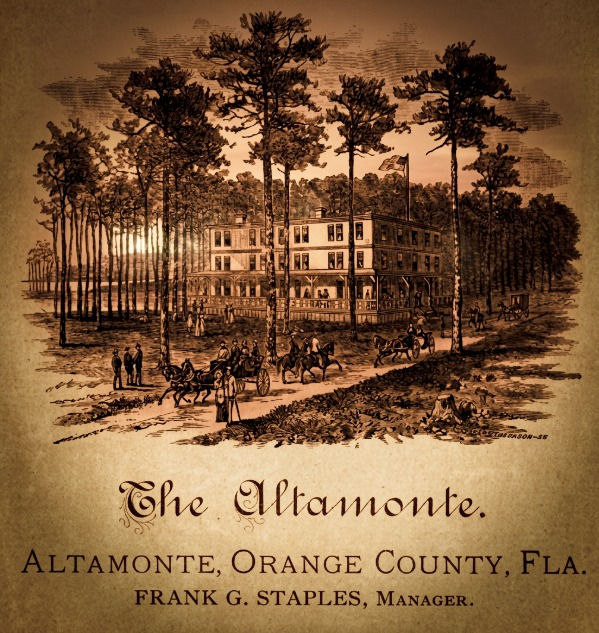
In the year 2015, I released Citrusland: Ghost Towns & Phantom Trains, my second book on the history of Central Florida. A Historic Novel, the people and events are all true. The book takes the reader on a journey aboard The Orange Belt Railway from Sanford to Oakland weeks after the great freeze. Along the way you meet the pioneers who cleared the land and founded railroad towns of Sylvan Lake, Paola, Island Lake, Glen Ethel, Palm Spring, Altamont, Altamonte, Forest City, Toronto, Lakeville, Clarcona, Crown Point, and Winter Garden. Detraining at Oakland, the reader is then taken to the grave site of James G. Speer.
If you would like to learn more about the towns listed above and the Great Freeze of 1894-95, I invite you to check out my highly rated (6 Amazon ratings of 4.8 out of 5.0) Citrusland: Ghost Towns & Phantom Trains.
Visit my Amazon Author Page

Citrusland: Ghost Towns & Phantom Trains
4.8 out of 5 From 6 Verified Ratings
Verified Reviewer


Comments