
That Time Altamonte tried to return to Orange County
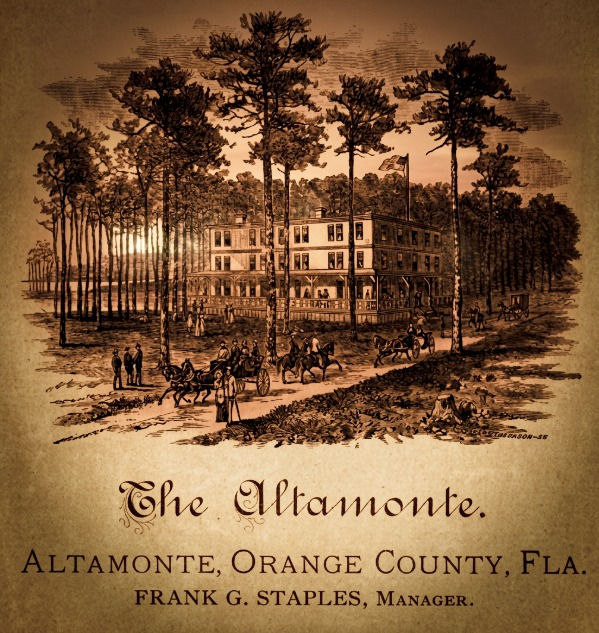
The Altamonte Hotel, Orange County, Fla. (circa 1883)
The time was 1920, June 18th to be exact, just as America’s notorious Roaring 20s and another state-wide land boom were just beginning. It was on that date that a number of well-respected residents of Altamonte Springs met “to take action”. The Orlando Sentinel of June 19th told of the event, “a Protest Against Neglect,” the newspaper said. Altamonte Springs citizens wanted a “Separation from Seminole County.”
A new Seminole County in 1913 ended nearly 40 years of discontent among some Sanford old-timers. It had been in early 1874 that Henry S. Sanford confronted Jacob Summerlin on the front porch of Summerlin’s Orlando hotel to argue that the county seat should be located at Sanford, on Lake Monroe, rather than in Orlando, a cow-town in the middle of the wilderness.

Summerlin persuaded the County Commissioners to stick with Orlando by building a dazzling new three-story courthouse. Some folks, however, never forgot, while others in the new county were not exactly pleased, which in turn led to the Altamonte Springs meeting in 1920.
Among the residents in attendance on the evening of 18 June 1920 were Howard Lyman, Walter Ballard, Charles Haines, Edward Cotting, Gordon DeRanus, James Osteen, Ambrose Mullen, Joseph Lewis, Albert Cline, George Kingsley, Arthur Fuller, Andrew Haines, Edward Mitchell, Charles Dallas, Edward Mitchell, W. Sinclair and James Cotting. And before these gentlemen adjourned that evening, each had signed their name to an official resolution.

The Fuller Family Residence, Altamonte Springs, FL
“The city of Altamonte Springs, in mass meeting assembled, this 18th day of June, in the year of our Lord 1920, unanimously declare it to be our wish and resolute purpose to have Altamonte Springs made a part of Orange County, from which county, by legislative enactment, without our consent, and against our vigorous protest, we were divorced and made part of the new county of Seminole.”
The resolution explained the residents concern well: “Whereas, Altamonte Springs, since it was made part of Seminole County, has been, through neglect and indifference, absolutely ignored by officials of the county, and no heed given to complaint or protest, which were vital to the welfare of our people, and development of this vicinity; and whereas, our main avenue was paved a width of but ten feet and our other thoroughfares have during this period been neglected; and whereas, the county seat of Orange County is but nine miles distant and that of Seminole County fourteen, of much inferior roads; the divorce was unnatural and unholy; and whereas, it is not the policy or purpose of the people through their chosen representative at Tallahassee to subject any part of the citizenship of the commonwealth of Florida to unnecessary inconvenience, to taxation without the receiving fair and equitable returns from such taxation, or to force upon them an obnoxious government which has proven detrimental to their welfare; therefore. Be it resolved that a legislative committee of twenty-one be appointed to appear before the legislature, when next in session in Tallahassee, and to see that legislation be enacted placing Altamonte Springs again in Orange County.”
The county’s divorce of 1913 split Altamonte Springs and Maitland, two close-knit cities with ties dating as far back as when the two original settlements were formed in the early 1870s. The first north-south street in Altamonte was Maitland Avenue, used by the earliest settlers of Altamonte Springs, back when the community was known as Snowville, to receive their mail at Maitland. Dividing the county between the two communities contributed to the discontent among citizens who had interests in both communities.
Orange County Responds:
As one might expect, Orange County responded favorably in an article published on 20 June 1920 in The Orlando Sentinel. “We are gratified that the citizens of Altamonte Springs recognize a good thing when they see it, namely Orange County. Altamonte Springs would like to get away from Seminole County and join Orange County, and the people there have signified their intention by drafting a resolution and appointing a legislative committee to take action. The matter is of importance, first because the Altamonte Springs people have taken the initiative, and second, because they want to get into a county, which is more their home and will give them more for taxation. It is a move which will be supported by Representatives Newton and Griffith and Senator Overstreet, no doubt, as these officials recognize that Altamonte Springs would be a substantial addition to this county.”
Altamonte Springs’ resolution obviously failed in its attempt to return the city to Orange County, and today, the 1920 attempt to do so is but one of many fascinating forgotten stories found in my 2024 book, Altamonte: A History of Altamonte Springs, Florida. A settlement first established in 1874 by Civil War veterans as “Altamont,” a nearby resort community for New Englanders then borrowed the name in 1882, added an “E”, and quickly developed into the town of “Altamonte”. Two separate railroads of the 1880s departed Sanford, one bound for Altamont, the other having a stop at Altamonte, and so to end confusion Altamont became Palm Springs; Altamonte became Altamonte Station, then, Altamonte Springs.
Problem solved? Not exactly, for with the dawn of Florida’s 1920s Land Boom Sanlando, San for Sanford and lando for Orlando, incorporated parts of old Altamont and Altamonte – but do not fear, Altamonte: A History of Altamonte Springs, Florida (2024) has it all – including the long forgotten “Hermit” of Hermit’s Trail, and so much more.
Altamonte: A History of Altamonte Springs, Florida
Available at Altamonte Springs Library and
Casselberry Library. Buy a copy at the
Seminole County History Museum, or

CRONIN HISTORY BOOKS MAKE GREAT HOLIDAY GIFTS
NEW from Richard Lee Cronin - SEVEN: Mysteries of an Age of Discovery
See also www.CroninBooks.com


Comments