
Orlando's Elusive Ghost of Lake Highland

That Lady of Orlando’s Lake Highland
“Strange Unexplained Sightings”
During a Lake Eola festival in 2019, two schoolteachers from nearby Lake Highland Preparatory School stopped at my booth to ask if I knew anything about strange paranormal type activities in that area. My answer, I think, surprised them, as I told them about a social media post I first made in 2015 and reposted in 2018. That earlier Ghost of Lake Highland article was made early in my new “retirement” career as an author and historian, so only a few followers had ever read that post. So, three years later, in 2018, after the number of my followers had grown, I ran that first post again. Even then, though, my audience was rather small.
The two teachers from Lake Highland Preparatory School said their reason for asking me was that “strange unexplained sightings were often reported at the school.” I told the two about my prior posts and we talked about possibly meeting again to discuss the mystery sightings further. We never did get that opportunity though.
My primary interest has always been history rather than paranormal activity, which was why I made my first post in 2015. I had read the 1938 account of a legend of a Lake Highland ghost, anstory written by author Kena Fries, and I decided to attempt to resolve the mystery through researching history.
The Lake Highland Ghost legend was told by Kena Fries, daughter of Surveyor John Otto Fries, in Chapter 32 of her 1938 book, Orlando in the Long, Long Ago. The legend as told by Kena is as follows:
“In the early eighties, the Webbers built a house in a large orange grove, later selling to a young Englishman, who had the house beautifully ‘interior decorated’ and furnished. He and his bride, a handsome English girl, entertained their friends lavishly. A jolly Christmas party, the guests left long after midnight. In the darkened house the hosts slept peacefully. In the early morning the wife awoke, a choking sensation in her throat. The room was filled with smoke, and lurid flames leaped about the building. Frantic efforts failing to arouse her husband, she ran to the nearby water plant, clad only in her night robes. The husband was rescued unhurt; the house burned to the ground. The wife never recovered, dying a few months later. After that for many years, just before sunrise on the morning of December 27th, her form could be seen floating among the orange trees, from the charred remains of the old house to the water plant, where it dissolved into thin air and vanished. Perfectly trustworthy persons, returning from night duty, or going to begin the new day’s work firmly believed in the vision.”
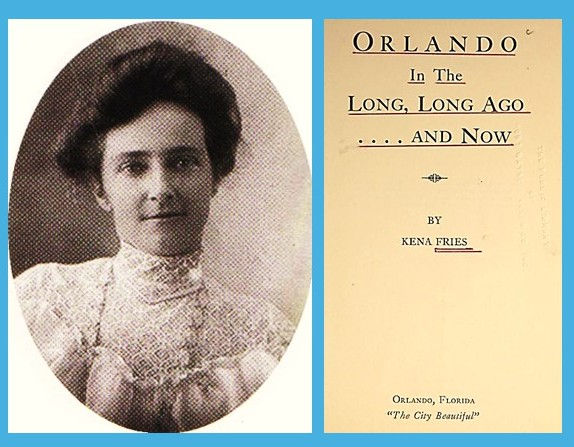
Miss Kena Fries (1867-1945), Author of Orlando in the Long, Long Ago
A Mystery too Easily Solved?
Miss Kena Fries had provided ample clues to prove or disprove the 19th century legend. Kena’s mention of the Webber family; the early eighties (1880s); and Orlando’s water plant made solving the mystery much too easy. Or, so I thought.
For starters, Miss Fries led me directly to the Lake Highland area north of downtown Orlando, the location of the 1880s water plant. Frank R. Webber, of St. Albans, Maine, homesteaded 160 acres in 1884 adjacent to Lakes Ivanhoe and Highland. Orlando’s first water plant was located adjacent to Frank Webber’s property. Built in the mid-1880s, the water plant pumped water out of Lake Highland to downtown Orlando, a mile and a half to the south.
Frank and Sarah Webber’s family helped solve the next clue. They had built two homes, one as a winter residence for themselves, and the other for their daughter, Francie M. Webber, the “bride” of John Haley Lord, the “Englishman” of New England. The Lord’s lived directly behind the Webber’s residence, only the Lord’s house fronted a dirt road that is now Highland Avenue.

1886 Orlando & Winter Park Railroad, Plat Book B, Page 41
The 1886 Plat recorded in Orlando by the Orlando and Winter Park Railroad shows both the residence of “F. R. Webber” on Webber Street (now Weber Street), and the residence of “Mrs. J. H. Lord” facing the County Road (now Highland Avenue). The two homesites are outlined in purple, and Lakes Ivanhoe and Highland are outlined in red on the above Plat.
On February 12, 1887, the newly formed Orlando Water Company was given the right-of-way by “J. H. & Francie Lord” to access their property for the installation of pipes. Various deeds were recorded by both Francie and her husband in the next several years, with the last recorded deed appearing in 1893.
Then, “on the night of December 29, 1894,” said Orange County resident Benjamin M. Robinson, “a freeze occurred in Florida,” with an even worse freeze occurring seven weeks later. Could that have been the same Christmas season that a fire destroyed John & Francie Lord’s house?
Did Francie (Webber) Lord “never recover”; dying of that traumatic event a few months later? Was Francie our Ghost of Lake Highland?
Neither the Webber family nor the Lord family is found in the 1900 Orlando census. One could easily assume, therefore, that Francie Webber Lord is indeed the woman “trustworthy persons working at the water plant saw floating among the orange trees” for many years.
The correct answer to both questions is NO!
Imagine my surprise four years later, while researching the history of Sarasota, when I learned that John H. Lord and his father-in-law, Frank R. Webber, had become largescale developers of that city in the early 1900s. As I explain in my book To Sarasota, With Love, Orlando, “Francie Mabel (Webber) Lord arrived in Sarasota, according to the Tampa Tribune of March 24, 1900, with her two daughters. Francie later became the proprietor of the Sarasota House Hotel at Five Points, in downtown Sarasota.
Clearly, Francie (Webber) Lord was much too busy in Sarasota to be floating through orange trees near Lake Highland in Orlando during the pre-dawn hours every December 27th.
Back to the Drawing Board (or rather, Back to the 1886 Plat):
The Highland Preparatory School was later built on property said to be owned in 1886 by “J. W. Anderson” (note the J. W. Anderson parcel on the 1886 Orlando & Winter Park Railroad Plat above). The one fellow everyone loved during the summer months in Orlando, John Anderson managed the Icehouse. He and wife Emily had arrived in Florida from Iowa in 1881, settling on the Lake Highland parcel by 1886.
John W. Anderson was a Union Veteran in the Civil War. Serving in the 19th Iowa Infantry, he had served at the Battle at Jenkins Ferry, described as a horrific battle. A Confederate soldier in this same battle wrote: “The ground was thickly strewn with ghostly mangled forms. It was almost too horrible for human endurance. No conception of the imagination, no power of human language could do justice to such a horrible scene.” One thousand men died at Jenkins Ferry, half Union, half Confederate.
After the War, John W. Anderson returned to Iowa. In 1874, he married Adeth Bell Gibson, and on October 6, 1875, Adeth gave birth to a son, Peter. A second boy was born to John & Adeth in 1876, but in 1877, Adeth (Gibson) Anderson and her first born son both died.
John W. Anderson remarried in 1881. His bride, Emily Gibson, was the younger sister of his first wife Adeth. That same year, the Anderson's departed Iowa. John, his bride Emily, and one son from his first marriage all relocated to Orlando, Florida. Emily (Gibson) Anderson died in 1910, eliminating her as a candidate for the Ghost of Lake Highland).
The Lake Highland property John and Emily settled on was not originally deeded to him. Emily (Gibson) Anderson inherited the parcel upon her father’s death. Sisters Adeth and Emily Gibson were the daughters of Peter & Emily (Low) Gibson of Ryegate, Vermont. The father died at his Vermont home on January 2, 1892, and upon his death, the Orlando property went to Peter’s only living relative, his daughter, Emily (Gibson) Anderson.
Peter Gibson (1821-1892), buried in the Ryegate, Vermont cemetery, was memorialized in a 1913 History of Ryegate, Vermont, a history prepared by Edward Miller and Frederic Wells. A handsome tombstone also memorializes the lives of Peter, his wife, and daughters. Peter’s wife, according to the Ryegate tombstone, died December 23, 1883. According to the 1913 Miller & Wells History of Ryegate, Vermont, Emily Low Gibson had died "at Orlando, Florida”.
Snowbirds, Peter & Emily Gibson were spending the winter of 1883 on the exact property where Lake Highland Preparatory School now stands. Emily died there on December 23, 1883, and according to Kena Fries, “for many years, just before sunrise on the morning of December 27th, her form could be seen floating among the orange trees, from the charred remains of the old house to the water plant, where it dissolved into thin air and vanished. Perfectly trustworthy persons", said Kena Fries, "returning from night duty, or going to begin the new day’s work firmly believed in the vision.”

Peter & Emily Gibson family history, Ryegate, Vermont
Do YOU have a Lake Highland unexplained sighting to share? Tell us about it in the Comments section of my Facebook posts.
FLORIDA HISTORY makes Great Holiday Gifts


Comments